
Following extensive research and conversations with producers, location managers and sustainability professionals, alongside a deeper understanding of the farms within our network, we’re excited to introduce our new Sustainability Filter Tags on our website!
Designed to make sustainable location scouting more accessible, the new tags help productions identify the sustainability features, facilities and resources available at individual farms when exploring locations and making their final decisions. This makes it easier to compare locations, make informed decisions and find farms that align with a production’s practical requirements and sustainability ambitions.
For production teams, this means sustainability can be integrated into their search from the very beginning. Productions can use our new search filters to narrow location shortlists against desired facilities, resources, transport links, biodiversity features, accommodation, waste solutions and other infrastructure already in place at our farms. For farm owners, the tags offer another opportunity to showcase their useful features more clearly.
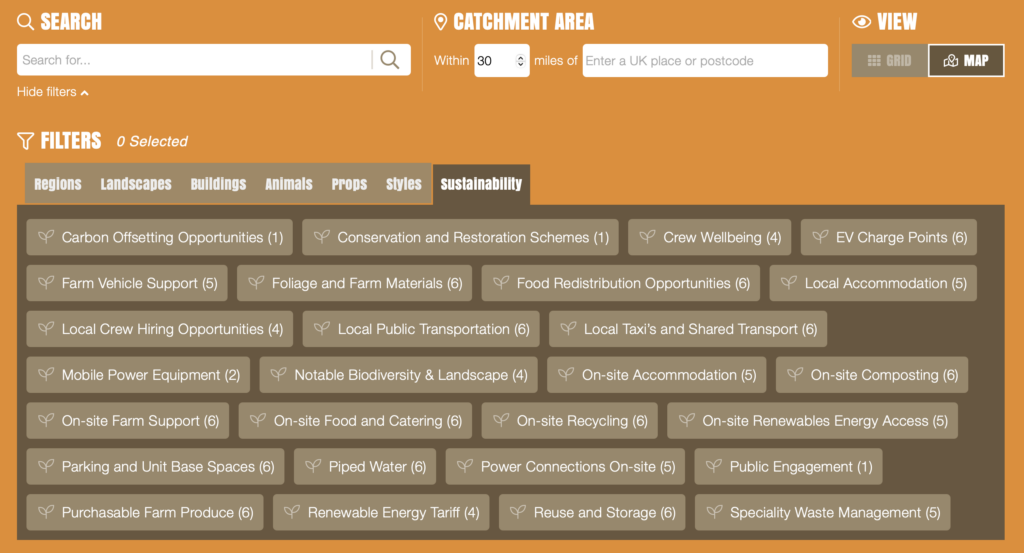
Upfront Sustainable Visibility for Website Users
The new Sustainability Tag filters bring greater visibility to the diverse sustainability features available across Britain’s farms and rural spaces. From renewable energy and EV charging to accommodation, waste and recycling facilities, biodiversity initiatives, in-house catering, all kinds of farm services and crew wellbeing, these tags are also expected to inspire productions to broaden their expectations of what a shoot location can provide in support of their own sustainable goals.
Just as importantly, the tags highlight the individuality of any farm location. Every location has its own combination of resources, facilities and environmental features, making it easier for productions to find the right fit for their project.
The tagging system is designed to capture the sustainable diversity and reflect the individual strengths of each farm location. We don’t expect every location to offer every feature. Instead, the tags provide a practical framework for understanding what each farm already has in place and will be backed up with further detail on request.
The information is being incorporated into individual detailed farm profiles, allowing users to dig deeper below the tags when they need to
Our aim is to make existing resources more visible and for productions to engage more with on-farm resources before finalising what is imported into the location.
By making these features easier to identify, we are starting more meaningful conversations with our farm owners about what productions are looking for, what resources are already available and what could realistically be developed over time.
A Living System
The Sustainability Filter Tags are not a finished checklist. They’re part of an evolving approach that will continue to develop as we learn more about our farms, listen to our production clients and better understand the changing sustainability needs of the industry.
As part of our wider sustainability initiative, Project Green and Brown, we’re continuing to gather information from our locations and are nearing completion of a Green & Brown Farm Guide, bringing together detailed resources and practical guidance.
Over time, we’ll be sharing more Farm Location Case Studies to demonstrate real examples of sustainability in practice, helping productions and farm owners learn from one another and continue building on sustainable practices on location.
Our farms are much more than backdrops. They are working environments, homes, businesses, habitats and landscapes, each with its own resources, character and story.
We want to help productions make the most of these resources responsibly, while supporting our landowners in developing sustainable opportunities that are practical, meaningful and appropriate for their individual farms.
Explore our locations, use the new Sustainability Filter Tags when scouting, and discover what farms can offer your next production.
Tag Glossary
The following is a complete list of the Sustainability Filter Tags:
Heating and Energy
Renewable Energy Tariff: Whether electricity is supplied through a renewable energy tariff or renewable energy provider.
On-site Renewable Energy Access: Examples include solar panels, wind turbines, battery storage or other renewable systems that productions can access.
Power Connections On-site: Available power connections, capacities and locations, including standard sockets, 3-phase power and generator hook-up points.
Mobile Power Equipment: Availability of generators, battery units or other portable power equipment for use across the site.
Water Supply
Piped Water: Availability of water sources such as mains supply, reservoirs, ponds, lakes or boreholes for production use (SFX, vehicle cleaning etc.)
Public Transportation & Vehicle Use
EV Charge Points: Multiple, location and charging capability of EV charge points available
Local Public Transportation: Proximity to nearest train station, bus routes etc. This is already written in some listings.
Local Taxis and Shared Transport: Availability of local taxi firms, transfer services or shared transport options that can support crew travel.
Parking and Unit Base Spaces: Hard-standing areas suitable for cars, unit vehicles and HGVs, plus any overflow parking options.
Farm Vehicle Support: Availability of on-site vehicles such as 4x4s, utility vehicles or trailers to move crew and equipment around the site.
Crew Wellbeing
Crew Wellbeing Opportunities: Walking routes, forest bathing, farm tours or other wellbeing activities available on site or nearby.
Accommodation
On-site Accommodation: Type and capacity of accommodation available on the farm or estate for cast and crew.
Local Accommodation: Nearby hotels, B&Bs or holiday lets and their approximate distance from the site.
Waste Recycling & Repurposing
On-site Composting: Availability of composting facilities for food waste, green waste, etc (on on-site).
On-site Recycling: Availability of recycling facilities for mixed recycling and or other materials (on-site).
Speciality Waste Management: Examples include hazardous waste, metal recycling.
Food Redistribution Opportunities: Access to local organisations that can support waste reduction, reuse, donation and recycling. Whether surplus food from productions can be shared, donated or redistributed locally.
Equipment for Hire and Support
On-site Farm Support: Availability of machinery, fencing, straw bales, reclaimed materials, animals or other farm assets for use as props or set dressing. Practical support available, such as grounds maintenance, vehicle operation, prop supply, earthworks or animal handling.
Reuse and Storage: Whether production materials, props or set items can be stored, reused or repurposed after filming. Farms that are open to retaining and reusing pieces of set
Foliage and Farm Materials: Availability of plants, foliage, timber or other natural materials from the farm or local area, including opportunities for reuse or composting.
Local Crew Hiring Opportunities: Proximity to nearest urban centre (for longer shoots) for access to local crew, kit and SA’s.
Catering and Food
On-site Food and Catering: Availability of on-site cafés, farm shops, catering services or farm produce that can support crew catering.
Purchasable Farm Produce: (eggs/milk vending machines) – Availability for crew catering/craft, reducing need for additional purchases.
Sustainability Projects and Initiatives
Carbon Offsetting Opportunities: Tree planting, hedgerow planting, habitat creation, woodland expansion or other environmental projects that productions can support, that occur on-site. Participation in Woodland Carbon Code, Biodiversity Net Gain, carbon farming schemes or other recognised environmental credit schemes.
Public Engagement: Partnerships with wildlife trusts, charities, community groups, volunteers or other local organisations. School visits, workshops, guided tours, open farm access or other public engagement activities.
Biodiversity & Nature
Conservation and Restoration Schemes: Examples include rewilding, habitat restoration, wetland creation, hedgerow planting, woodland creation or wildlife monitoring projects.
Notable Biodiversity & Landscape: Notable natural landscape or biodiversity features which could improve on-screen value, i.e. woodland (managed or unmanaged), waterways, wild meadows etc.
Partnerships with Nature Trusts and Preserves: RSPB / Wildlife Trusts / Soil Associations